
By Noemi Nagy-Bhavsar, founder of Beyond Move and the Women's Fitness "Pilates Doctor" · 19th November 2026
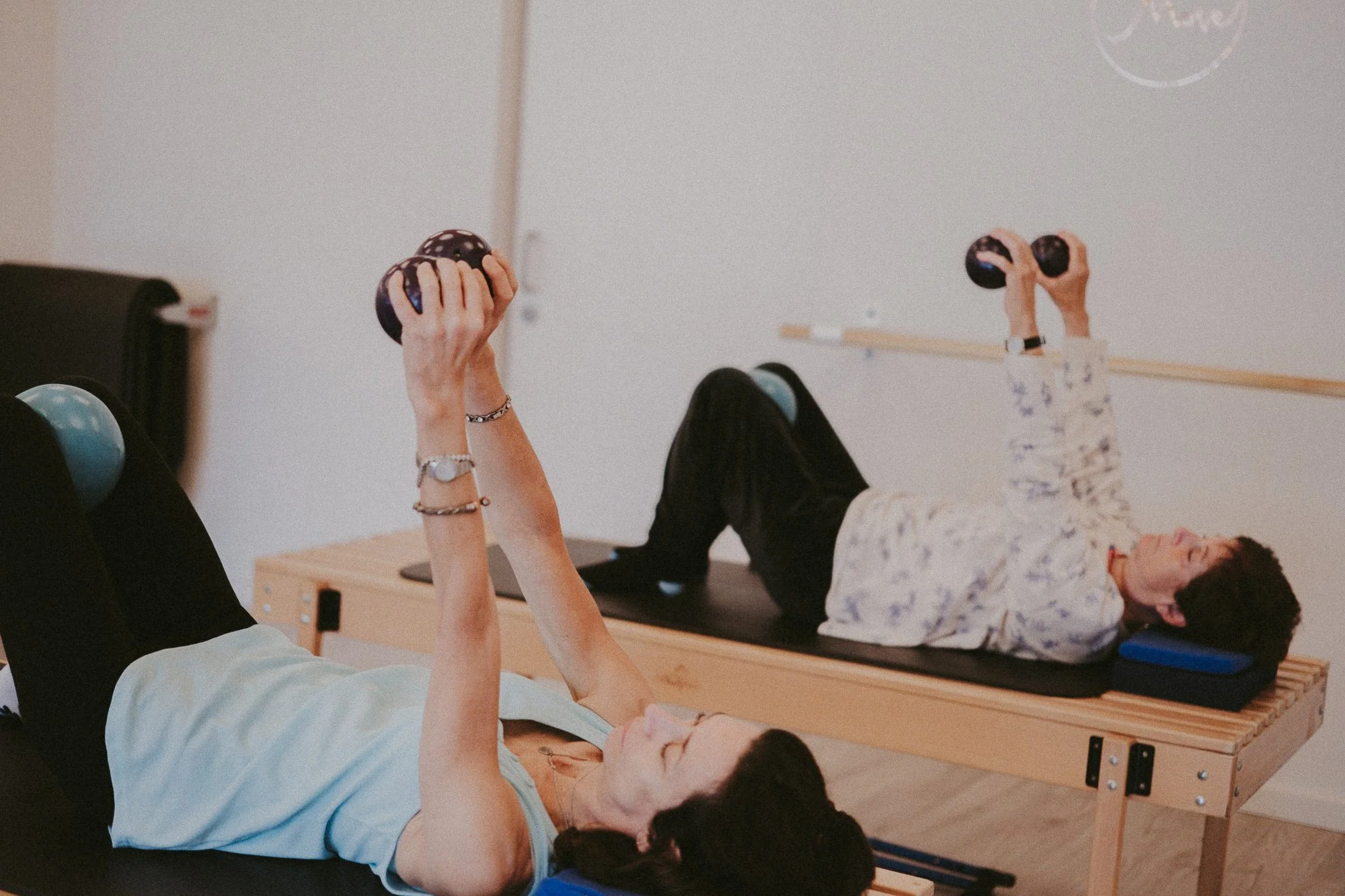
If you have MS and you're scared to walk into a Pilates class, that fear is real. You might pull a muscle. You might flare something up. I can't promise you that nothing will ever go wrong. MS doesn't work that way, and neither does the body's learning curve. But doing nothing isn't the safer option. It just feels safer.
The research agrees. A 2026 review of the studies found Pilates may improve mobility, balance, walking endurance, fatigue and quality of life in people with MS, although the authors say more high-quality trials are needed.
Why I work this way
I trained at the International Petö Institute in Conductive Education, a method built specifically to help people with neurological conditions move. What matters isn't just the exercises. It's the rhythm, the speed, the tone of voice you use to teach. That changes what someone with a neurological condition can actually do.
In 2006 I made the decision to work with adults. I found them more self-motivated, and that's how people with MS first came into my world. I spent eleven years at a skills development centre, working across cerebral palsy, Parkinson's and head injuries. That work shaped everything I know. Once I trained as a Pilates instructor alongside it, I saw how much the two methods had in common, but Pilates goes deeper into the muscles and alignment. That combination is what I bring to this work now.
MS affects everybody differently. Some people have spasticity, where muscles are stiff or spasm. Some have ataxia, a loss of coordination that affects balance and walking. Some have speech difficulties. Progressive MS needs a different approach, often more specific, sometimes with attention to speech. Someone newly diagnosed has a different job: maintaining range of movement in the shoulders, hips and ankles, before things have the chance to tighten and limit.
What actually makes it safe
Everyone fills in an intake questionnaire. We ask directly whether their GP or MS team has recommended exercise. From there, we assess the person, not the diagnosis. Our classes stay small, up to eight people.
In the room, that means being close to the barre. Offering a chair. Doubling up mats. Using a headrest, or whatever the person finds useful. It means starting at a general level and only building up once someone feels confident. It means watching for fatigue and stepping in early, with encouragement, with a hand on the shoulder, with a cue to adjust posture before it becomes a problem. It means never leaving someone alone on the hardest balance exercise. We stay close, by the wall, ready.
It also means keeping the room at the right temperature. Many people with MS find that heat, including the warmth your body builds during exercise, temporarily makes their symptoms worse. We watch for overheating as closely as we watch for fatigue.
You cannot learn not to fall. It's frightening, but a person needs to learn how to fall and how to stand back up without panicking. The only way to learn that is by experiencing the wobble while it's still small and safe.
The teaching itself is part of the treatment
How you speak changes what the body can do. That's what Conductive Education taught me before Pilates did.
For someone with spasticity, the voice slows right down. You give them time to reach a position, hold it, and return, speaking calmly, almost letting the pace of your voice set the pace of their nervous system. Do that consistently and the movement gets smoother session by session, and you build complexity from there.
For someone with ataxia, it's the opposite. They don't need slowness. They need a firmer, clearer prompt to initiate the movement and to stop at the end, rather than overshooting. Wide-base balance positions. A decisive tone. Same method, different delivery entirely.
This is why a generic Pilates class, or an app, isn't the same as working with someone trained in the condition. Pilates can help almost anyone. But teaching someone with MS means knowing MS: what to look for, what a flare looks like starting, when fatigue is turning into something more. That comes from training and practice, not a class plan.
Physiotherapy often, and rightly, targets one problem at a time: spasticity here, swallowing there. I look at the whole person: strength, balance, different starting positions (standing, sitting, kneeling, side-lying, prone), moving in different directions, not just stretching. Head to toe, one system, because the body and the mind can't be separated in this work.
Fatigue is not a failure
MS fatigue isn't only physical. This kind of movement work takes real cognitive concentration too, and that's its own kind of tiring. So we watch closely. If someone isn't moving with their usual freshness, we slow the pace, reduce the intensity, encourage water and rest, without making it feel like a failure. Taking a break mid-class doesn't mean the class isn't working for them.
Afterwards, I tell clients: hydrate, rest, don't pack the rest of your day. Recovery is part of the exercise, not separate from it.
What inclusion looks like
At Beyond Move, people with MS aren't placed in a separate MS-only class. They're integrated into our general classes. Getting there takes some initial one-to-one time, understanding their body, their triggers, their limits. Once that groundwork is done, it works. Support and integration aren't opposites here. They work together.
One client comes to mind. She's lived long-term with MS, with significant back pain and spasticity, and she tires quickly. She still comes to class, talks with the others, and the group is quietly in awe of her courage and her stamina. Every session, her standing and her confidence in the movements improve a little more. That's what this work offers beyond the physical: connection, movement built for her specific needs, and confidence that compounds.
Moving someone into a general class isn't automatic. It only works when the person is ready and motivated to try, and when we as teachers are genuinely set up to meet their needs in that setting. Sometimes it doesn't work the first time. We learn from that and adjust, for them and for us.
Keep moving
Find a place where you feel you belong, with a teacher who understands your needs. Whatever range of movement you have, and whatever range is a little limited, the goal is to maintain it for as long as you're willing to work at it. With the right approach and the right teacher, the body and the mind get you there together.
Pilates teachers trained in neurological conditions are still rare in North London. At Beyond Move, every client with MS starts with one-to-one time before joining a small group class.
Ready to start? Book an initial one-to-one session at Beyond Move, 9 Cat Hill, Barnet. [Book your session] or email hello@beyondmove.com to talk it through first.
Noemi Nagy-Bhavsar
This article is general information, not medical advice. Check with your GP, neurologist or MS nurse before starting a new exercise programme.
